
INSTITUTE FOR STANDARD AND QUALITY DEVELOPMENT STUDIES


Natural mineral water and bottled drinking water are products widely consumed in daily life and have a direct impact on consumer health. Certification of conformity for natural mineral water and bottled drinking water according to QCVN 6-1:2010/BYT not only helps businesses evaluate product compliance with applicable regulations but also contributes to enhancing credibility and reputation in the marketplace.
Natural mineral water and bottled drinking water are products commonly used in everyday life and directly affect consumer health. Therefore, controlling product quality, water sources, treatment processes, and product labeling is always a matter of concern for many enterprises during production and market distribution.
Among these requirements, conformity certification for natural mineral water and bottled drinking water in accordance with QCVN 6-1:2010/BYT is considered one of the important bases for helping businesses assess the compliance of their products with relevant technical requirements.
Let ISSQ Quality Institute guide you through the certification process for natural mineral water and bottled drinking water under QCVN 6-1:2010/BYT in the article below.
QCVN 6-1:2010/BYT is the National Technical Regulation specifying food safety criteria and management requirements for bottled natural mineral water and bottled drinking water intended for refreshment purposes.
This regulation does not apply to functional foods.
QCVN 6-1:2010/BYT applies to:
According to QCVN 6-1:2010/BYT, natural mineral water and bottled drinking water are classified based on the characteristics of the water source, natural composition, and the carbon dioxide (CO₂) content present in the product after bottling. This classification helps businesses accurately identify product characteristics during production, labeling, and market distribution.
A bottled water product intended for direct consumption, which may contain naturally occurring or added minerals and carbon dioxide (CO₂), but is not bottled natural mineral water and does not contain sugar, sweeteners, flavorings, or any other substances.
A water product clearly distinguished from ordinary drinking water by the following characteristics:
The bottling of natural mineral water directly at the water source, or the transportation of water from the source to the treatment and bottling facility through a closed and continuous pipeline system while maintaining strict hygienic conditions throughout the extraction process and ensuring that the composition and quality of the natural mineral water remain unchanged from the source.
Natural mineral water that, after permitted technical treatments, retains a carbon dioxide content equivalent to that naturally present at the source.
Natural mineral water that, after treatment and bottling, does not contain free carbon dioxide in excess of the amount necessary to maintain dissolved bicarbonate salts in the water.
Natural mineral water whose carbon dioxide content after bottling is lower than the natural carbon dioxide level present at the original source.
Natural mineral water to which carbon dioxide collected from the same natural mineral water source has been reintroduced. After bottling, the carbon dioxide content may exceed the original level at the source.
Natural mineral water to which food-grade carbon dioxide has been added during production before bottling in order to create carbonation.
It can be seen that natural mineral water and bottled drinking water are classified according to the characteristics of the water source, natural mineral composition, and carbon dioxide content present in the product.
Understanding each product category not only helps businesses select appropriate production and labeling methods but also supports conformity assessment and product distribution in compliance with current regulations.
Obtaining conformity certification for natural mineral water and bottled drinking water in accordance with QCVN 6-1:2010/BYT not only helps businesses better control product quality but also contributes to enhancing credibility and facilitating business operations and product distribution in the marketplace.
The conformity assessment process helps businesses review and better control factors related to water sources, microbiological indicators, chemical composition, as well as production and bottling conditions.
For products consumed directly on a daily basis, such as natural mineral water and bottled drinking water, safety and quality are always key concerns for consumers. Having products assessed as compliant with applicable technical regulations can help customers feel more confident when choosing and using them.
Conformity certification demonstrates a company’s commitment to product quality and production safety control. It also contributes to improving professionalism and strengthening brand reputation in the marketplace.
Many distributors, agents, and business partners pay close attention to product quality documentation and regulatory compliance before entering into cooperation agreements or distributing products. Conformity certification can help businesses facilitate product distribution more effectively.
Conformity certification serves as one of the important bases for carrying out conformity declaration procedures for natural mineral water and bottled drinking water in accordance with current regulations.
Maintaining periodic assessments and surveillance activities helps businesses proactively monitor product quality, thereby minimizing issues that may arise during market circulation.
Conformity certification for natural mineral water and bottled drinking water in accordance with QCVN 6-1:2010/BYT not only helps businesses control quality but also contributes to strengthening brand reputation, increasing customer confidence, and improving business competitiveness in both domestic and international markets.
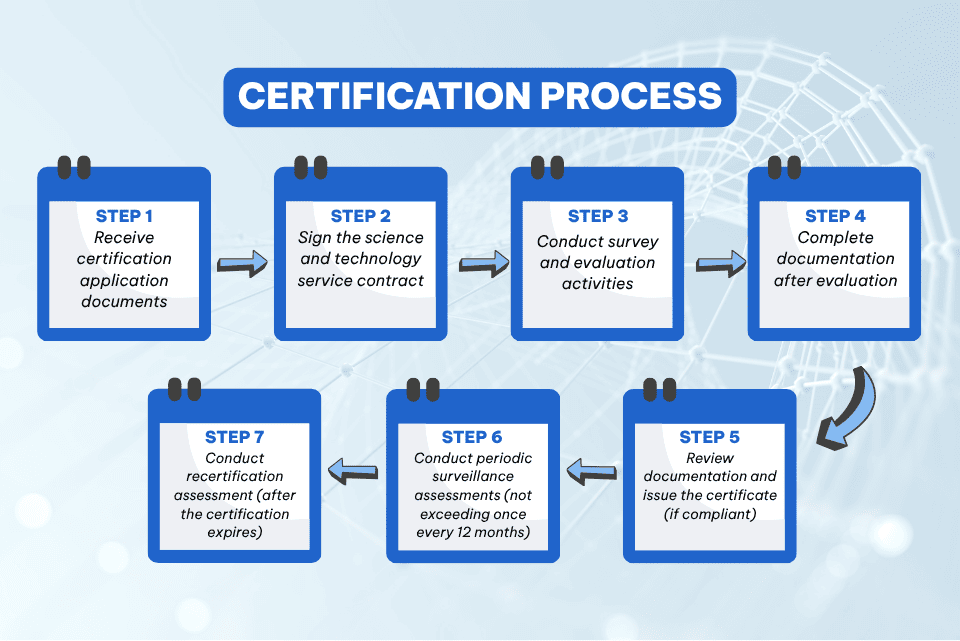
The conformity certification process for natural mineral water and bottled drinking water is generally carried out through the following basic steps:
Step 1: Receive the certification registration dossier
Step 2: Sign the science and technology service contract
Step 3: Conduct surveys and assessments
Step 4: Complete post-assessment documentation
Step 5: Review the dossier and issue the certificate (if requirements are met)
Step 6: Conduct surveillance assessments at intervals not exceeding 12 months
Step 7: Conduct recertification assessment upon certificate expiry
In addition to product quality and safety requirements, natural mineral water and bottled drinking water circulating in the market must also comply with labeling requirements stipulated in QCVN 6-1:2010/BYT and relevant legal documents.
The labeling of bottled natural mineral water and bottled drinking water must comply with the provisions of Decree No. 89/2006/ND-CP on goods labeling and relevant implementing regulations.
Information displayed on labels must be clear, easily recognizable, and consistent with the nature of the product placed on the market.
The product name must include the wording: "Natural Mineral Water"
Depending on the product category, the label must specify one of the following designations:
The name of the mineral water source and the geographical area where the source is located must be clearly stated on the product label.
The following information must be declared on the label:
If bottled natural mineral water contains fluoride at a concentration greater than 1 mg/L, the label must include the statement:
“Contains Fluoride.”
If bottled natural mineral water contains fluoride at a concentration greater than 1.5 mg/L, the label must include the statement: “Not suitable for children under 7 years of age.”
The following practices are prohibited:
Natural mineral water and bottled drinking water are products that directly affect consumer health. Therefore, controlling product quality, production conditions, labeling practices, and water sources remains a major concern for many businesses.
Natural mineral water and bottled drinking water are products that directly impact consumer health. Therefore, maintaining control over product quality, production conditions, labeling requirements, and water sources is an important consideration for businesses engaged in the production and distribution of these products.
Obtaining conformity certification for natural mineral water and bottled drinking water in accordance with QCVN 6-1:2010/BYT not only helps businesses assess product compliance with applicable regulations but also contributes to enhancing credibility and reputation in the marketplace.
In addition, businesses should pay attention to maintaining production conditions, conducting periodic quality control activities, and ensuring proper labeling compliance in order to minimize risks that may arise during product distribution.
If your company requires conformity certification services for natural mineral water and bottled drinking water in accordance with QCVN 6-1:2010/BYT, please contact ISSQ Quality Institute via:
for consultation and certification support.
Publication Date: May 25, 2026


