
INSTITUTE FOR STANDARD AND QUALITY DEVELOPMENT STUDIES


Coating paint is a common material in construction and industry, but lead compounds in paint pose significant risks to human health and the environment. To strictly control this issue, the Ministry of Industry and Trade issued QCVN 08:2020/BCT setting limits on lead content in paint, alongside Amendment 01:2026 QCVN 08:2020/BCT (effective from July 1, 2026) requiring mandatory conformity declaration prior to market circulation.
QCVN 08:2020/BCT certification is one of the key regulatory requirements for organizations and individuals manufacturing, importing, and trading paints within the governed scope in Vietnam. The standard focuses on controlling lead content in paint to minimize risks to human health and the environment.
Notably, starting July 1, 2026, Amendment 01:2026 QCVN 08:2020/BCT, issued under Circular No. 37/2026/TT-BCT, officially came into force. The new regulation continues to mandate that regulated paints must undergo a declaration of conformity matching QCVN 08:2020/BCT before being circulated on the Vietnamese market.
How dangerous is lead in paint? What does QCVN 08:2020/BCT specify? Why do paint manufacturers and distributors need conformity certification? What steps are involved in the process? Let's explore the details in the article below.
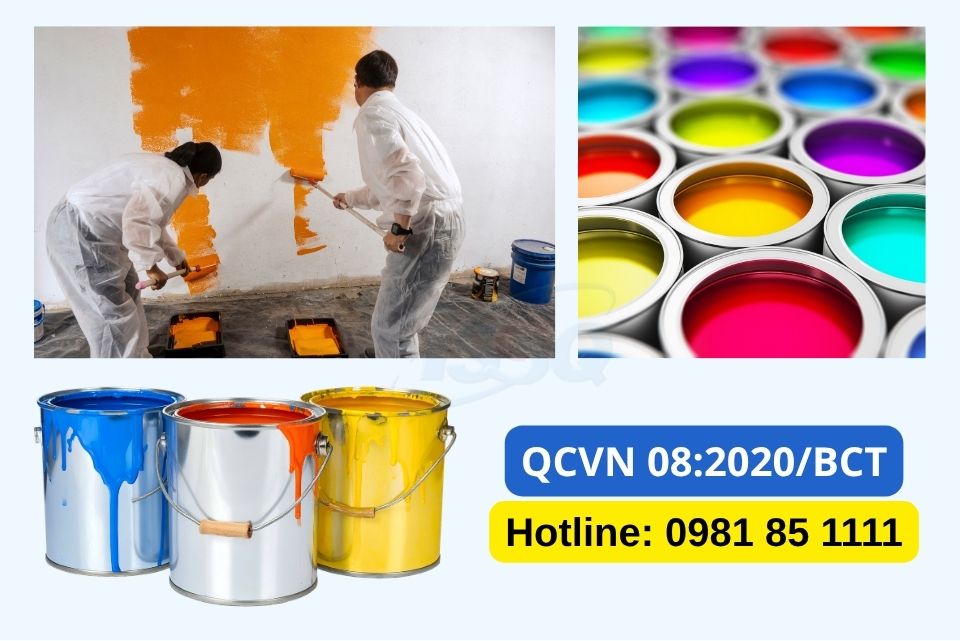
Paint is widely used in construction, manufacturing, consumer goods, interior decoration, and various other fields. During production, certain lead compounds may be added to provide color, enhance durability, or support specific technical characteristics.
However, lead (Pb) is a heavy metal that poses severe health risks under high exposure or prolonged contact.
This is precisely why controlling lead content in paint has become a vital issue for regulatory authorities, manufacturers, and consumers alike.
Paint containing unsafe levels of lead can become a exposure source during manufacturing, application, daily use, or when the paint layer peels and degrades.
Key high-risk groups include:
Workers directly involved in paint manufacturing and processing.
Painters and construction workers with long-term exposure.
Individuals in frequent contact with painted surfaces.
Children, especially in environments with flaking lead paint or dust.
Residents and workers in areas with potential lead exposure.
Lead impacts multiple organ systems in the human body. Therefore, controlling lead content at the manufacturing stage before market distribution is crucial to mitigating exposure risks.
In addition to health concerns, controlling lead in paint plays a significant role in environmental protection.
Throughout its lifecycle, paint generates waste during production, application, renovation, demolition, or old layer removal. Uncontrolled lead content in paint products can easily turn into an environmental hazard if waste is mismanaged.
Thus, controlling lead levels is not merely a technical requirement—it is a vital part of a business's responsibility toward consumers and the planet.
QCVN 08:2020/BCT is the National Technical Regulation on the Limit of Lead Content in Paint, promulgated by the Ministry of Industry and Trade under Circular No. 51/2020/TT-BCT on December 21, 2020, and effective since July 1, 2022.
The standard sets out technical requirements, test methods, and management mandates regarding lead content in paint prior to market release in Vietnam.
Applicable entities include organizations and individuals involved in:
Paint manufacturing;
Paint importing;
Paint distribution and sales;
State regulatory agencies;
Other relevant organizations and individuals.
It is particularly important to note that from July 1, 2026, QCVN 08:2020/BCT has been amended by Amendment 01:2026 QCVN 08:2020/BCT.
Under the amended regulation, the standard applies to paints listed under the product and goods categories managed by the Ministry of Industry and Trade, cross-referenced under Circular 33/2026/TT-BCT.
Lead Content Limits in Paint
QCVN 08:2020/BCT establishes a roadmap for controlling lead limits in paint:
| Implementation Timeline | Maximum Lead Content Limit |
| First 5 years from effective date | ≤ 600 ppm |
| After 5 years | ≤ 90 ppm |
Since QCVN took effect on July 1, 2022, the initial 5-year phase concludes on June 30, 2027. However, under the 2026 amendment, businesses must pay special attention to the updated management requirements active since July 1, 2026.
In other words, businesses should not rely solely on legacy QCVN 08:2020/BCT documents, but must incorporate Amendment 01:2026 when carrying out certification, declaration of conformity, and product distribution.
Under Amendment 01:2026 QCVN 08:2020/BCT, regulated paint products must undergo a formal declaration of conformity in accordance with the standard before being distributed in Vietnam.
Conformity declaration is executed pursuant to Article 13 of Circular No. 14/2026/TT-BKHCN regarding standard conformity declaration, regulation conformity declaration, and conformity assessment schemes for technical standards and regulations.
Therefore, paint manufacturers, importers, and distributors must proactively identify whether their products fall within scope and perform full conformity assessment steps as prescribed.
The primary objective of QCVN 08:2020/BCT is verifying lead content in paint.
Businesses should not rely solely on technical datasheets or supplier information to claim compliance.
Conformity assessment and laboratory testing provide objective, legally valid proof of whether a product complies with national technical parameters.
For manufacturers and importers, certification and conformity declaration form an indispensable part of completing a product’s legal file.
It also serves as proof to authorities that regulated products have been properly assessed against applicable technical standards.
During distribution, businesses may be required to present dossiers regarding quality, origin, and regulatory compliance.
Proactively completing the QCVN dossier mitigates operational risks during government inspections or when clients and commercial partners request proof of quality compliance.
Conformity certification under QCVN 08:2020/BCT offers substantial strategic value beyond legal compliance alone.
Provides a clear, valid foundation for fulfilling conformity declaration procedures, completing all necessary prerequisites for market entry.
The assessment process helps businesses systematically review lead content in paint formulations.
In the event of non-compliance, companies can re-examine:
Product formulas;
Raw material inputs;
Supplier quality;
Mixing and formulation processes;
Manufacturing controls;
Quality control protocols;
Storage conditions.
This enables early detection of root causes and continuous product improvement.
In a highly competitive paint market, safety and regulatory compliance are top priorities for buyers.
A complete conformity file significantly enhances trustworthiness when negotiating with:
Distributors;
Retail dealers;
Real estate developers;
General contractors;
Commercial partners;
Institutional clients.
Rather than competing solely on price, businesses can differentiate themselves through quality assurance transparency and verified safety.
For suppliers bidding on construction projects or large corporate procurement contracts, certification documentation is often a decisive evaluation criterion.
Failing to meet regulatory mandates exposes companies to penalties, product recalls, distribution halts, and reputational damage.
Proactively certifying and declaring conformity minimizes these operational threats.
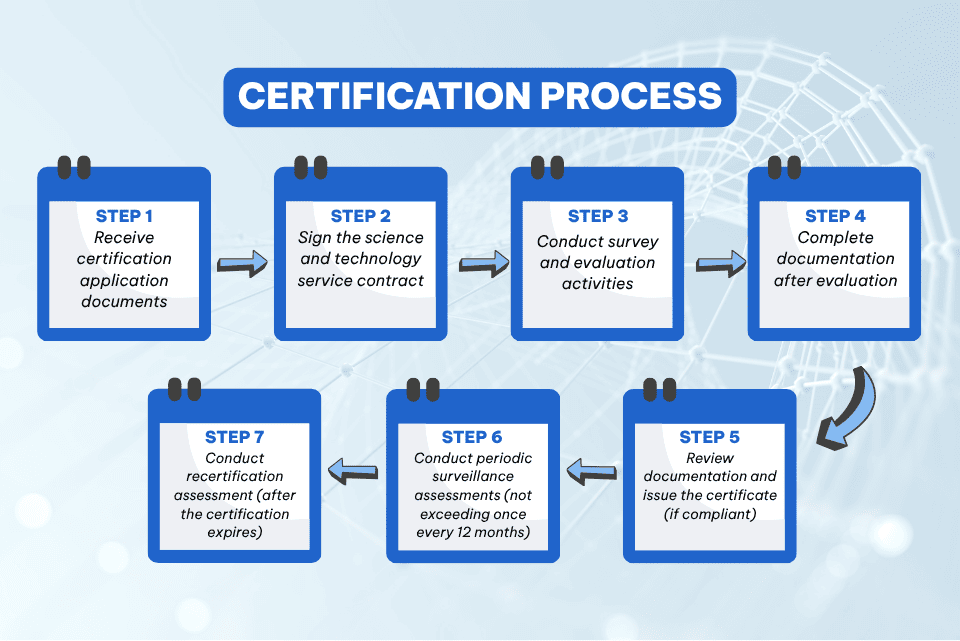
Step 1: Receive and review certification registration dossier.
Step 2: Sign technical service agreement.
Step 3: Conduct on-site audit and sampling.
Step 4: Finalize post-audit documentation.
Step 5: Dossier appraisal and Certificate issuance (upon compliance).
Step 6: Conduct periodic surveillance audits.
Step 7: Re-certification evaluation (upon certificate expiration).
If your company requires evaluation and certification under QCVN 08:2020/BCT, please contact ISSQ Quality Institute via hotline +84 981851111 or email vienchatluong@issq.org.vn | tcvn@issq.org.vn for assistance.


