
INSTITUTE FOR STANDARD AND QUALITY DEVELOPMENT STUDIES


ISO 22301 is an international standard for business continuity management systems. This standard can be applied to any organization regardless of its size, scope, type, or nature. The extent of application of the requirements depends on the operating environment and the complexity of the organization.
Business continuity is the ability of an organization to continue operating and maintain normal activities during unexpected issues, incidents, or disasters.
Business continuity not only ensures the survival of an organization during difficult situations but also helps enhance trust from customers and investors, while protecting the organization’s reputation. This standard can also help organizations improve their business performance and operational efficiency.
On May 15, 2012, the International Organization for Standardization (ISO) published ISO 22301:2019 – Business Continuity Management Systems. This standard specifies requirements for planning, establishing, implementing, operating, monitoring, reviewing, maintaining, and continually improving a documented management system to monitor risk mitigation processes, preparedness, response, and recovery after incidents occur.

The requirements specified in this standard apply to any organization or part of an organization, regardless of type, size, and nature, that wishes to:
The application of ISO 22301 follows the PDCA (Plan-Do-Check-Act) cycle with specific contents as follows:
Plan: Establish policies, objectives, targets, controls, processes, and procedures related to business continuity to improve performance and deliver results consistent with the organization’s overall policy and objectives.
Do: Implement and operate business continuity policies, controls, processes, and procedures.
Check: Monitor and review performance against business continuity policies and objectives, report results to leadership for review, and determine corrective and improvement actions.
Act: Maintain and continually improve the Business Continuity Management System by implementing corrective actions based on management review results and reassessing the BCMS scope, as well as business continuity policies and objectives.
The benefits for enterprises when applying and obtaining certification for a Business Continuity Management System include:
ISO 22301:2019 is an internationally recognized standard worldwide. Enterprises that apply and obtain certification for this standard can gain more opportunities for cooperation, international integration, expanded business prospects, competitive advantages in bidding, and sustainable development.
Building and implementing ISO 22301 requires investment in time, human resources, strong leadership commitment, and professional guidance from experienced experts.
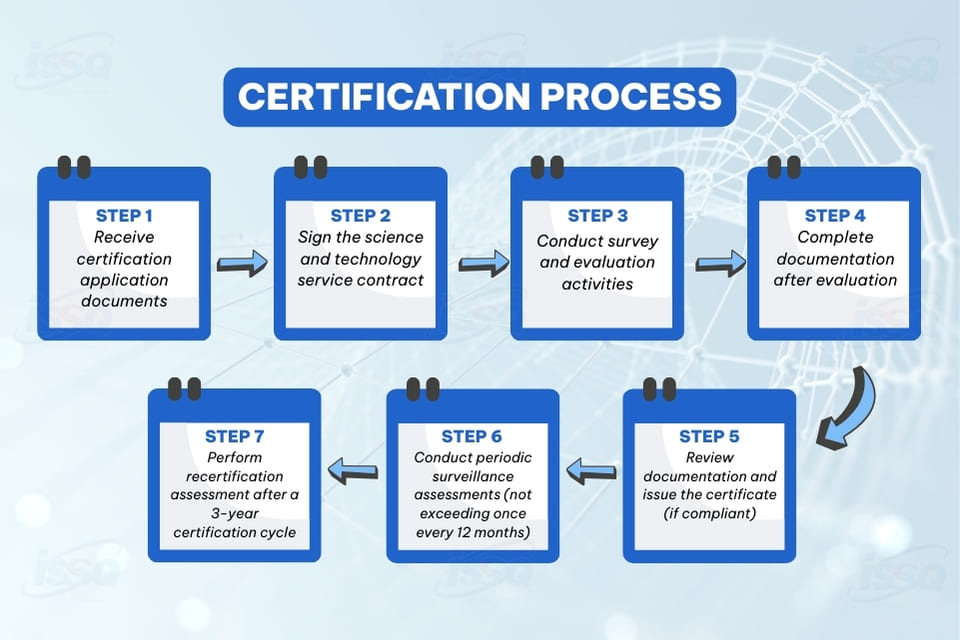
ISSQ Quality Institute is a science and technology organization under the Vietnam Union of Science and Technology Associations. The Institute has been designated with competence to certify various management systems and product conformity. It has also gained trust and cooperation from companies and organizations nationwide. The certification process for Business Continuity Management Systems at ISSQ includes:
Step 1: Receiving the certification registration dossier
Step 2: Signing the science and technology service contract
Step 3: Conducting on-site survey and assessment at the enterprise
Step 4: Completing documentation after assessment
Step 5: Appraisal of documents and issuance of certification (if compliant)
Step 6: Conducting surveillance audits every 12 months
Step 7: Conducting recertification audits (certificate validity: 3 years)
The above information provides an overview of ISO 22301:2019 certification for Business Continuity Management Systems.
We hope this article has provided useful and necessary information for readers.
ISSQ Quality Institute is always ready to accompany companies during integration and development.
Please contact hotline: +84 981851111 or email vienchatluong@issq.org.vn | tcvn@issq.org.vn. We are honored to serve our valued customers!
Publication date: 20/11/2023


