
INSTITUTE FOR STANDARD AND QUALITY DEVELOPMENT STUDIES


According to ISO/TC 176, the 6th edition of ISO 9001 is scheduled for publication on September 16, 2026, replacing ISO 9001:2015. For organizations currently certified under ISO 9001:2015, now is the ideal time to perform a gap analysis and prepare a transition plan rather than waiting until the deadline approaches.
ISO 9001:2026 is becoming one of the most discussed topics among businesses in the field of quality management. Over a decade after the release of ISO 9001:2015, the ISO 9001:2026 edition is being developed to align Quality Management Systems (QMS) with modern business environments, reinforcing leadership roles, quality culture, risk and opportunity management, and organizational adaptability in a shifting market landscape.
According to ISO/TC 176, the 6th edition of ISO 9001 is scheduled for official publication on September 16, 2026, replacing ISO 9001:2015.
For enterprises currently holding ISO 9001:2015 certification, now is the ideal time to begin gap assessments and prepare transition plans rather than waiting until the deadline approaches.
ISO 9001:2026 is the upcoming edition of the international standard for Quality Management Systems (QMS). Built upon the foundation of ISO 9001:2015, it introduces refined adjustments to clarify requirements and better reflect contemporary business realities.
ISO highlights that ISO 9001 is the most widely adopted quality management standard worldwide, boasting over one million certified organizations across 189 countries. The standard enables organizations to establish, operate, maintain, and continually improve quality management systems to satisfy customer requirements and boost operational efficiency.
Notably, ISO 9001:2026 is not a radical overhaul like the previous shift from ISO 9001:2008 to ISO 9001:2015. The core principles and foundational structure of the QMS remain intact, while key contents are clarified, reinforced, or restructured.
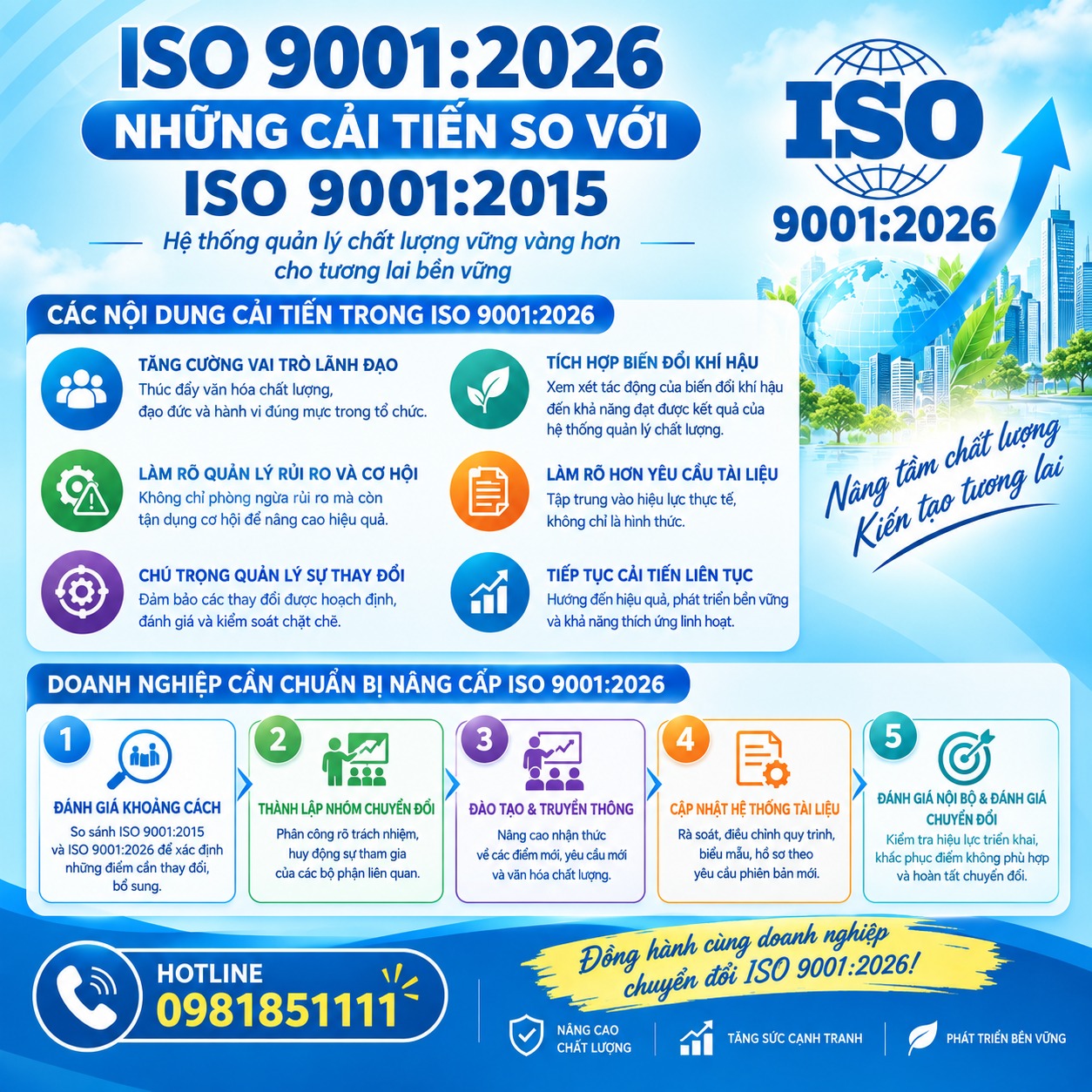
Key updates that require strategic attention from leadership involve quality culture, business ethics, risk and opportunity management, change management, and climate change integration.
2.1. Strengthening the Role of Quality Culture
ISO 9001:2026 places greater emphasis on top management’s responsibility to foster a strong quality culture and ethical behavior across the organization.
While ISO 9001:2015 required leaders to demonstrate commitment to the QMS, the 2026 version elevates expectations: leaders must actively cultivate an organizational climate where quality becomes an intrinsic element of daily operations.
This means businesses should go beyond simply maintaining:
A written quality policy;
Quality objectives;
Internal audit records;
Management review minutes.
Instead, organizations must demonstrate that quality is truly embedded in daily behaviors and workflows. Actionable initiatives include:
Quality culture awareness campaigns;
Quality responsibility training for all personnel;
Issue reporting and feedback mechanisms;
Encouraging employees to identify and report non-conformities;
Integrating quality metrics into department KPIs;
Leadership leading by example.
This focus represents one of the most significant shifts in ISO 9001:2026, alongside risk-opportunity management and change governance.
2.2. Clarifying Risk and Opportunity Management
ISO 9001:2015 introduced risk-based thinking, requiring organizations to identify risks, opportunities, and planned actions to address them.
In ISO 9001:2026, this methodology is refined with a clearer distinction between risks and opportunities.
This ensures businesses do not solely ask:
"What could go wrong and negatively impact the company?"
They must also explicitly address:
"What opportunities can we capitalize on to enhance performance?"
Consequently, the QMS shifts from purely error-prevention thinking to a dual framework of risk governance and opportunity exploitation.
Enterprises should review and update their:
Risk registers;
Opportunity catalogs;
Assessment criteria;
Prioritization levels;
Control measures;
Assigned owners;
Implementation results;
Action effectiveness.
2.3. Heightened Focus on Change Management
In today's fast-paced business environment, organizations constantly undergo change across multiple fronts:
Technology;
Machinery and equipment;
Software systems;
Personnel;
Vendors and suppliers;
Products and services;
Operational processes;
Market dynamics;
Regulatory standards;
Customer requirements.
ISO 9001:2026 reinforces requirements around change management within the QMS to ensure all changes are planned and executed in a controlled manner that supports achieving intended QMS outcomes.
Businesses must avoid implementing changes without evaluating their ripple effects. For instance, when switching raw material suppliers, the assessment chain should cover:
Change Event -> Risk-> Quality Impact-> Control Measures -> Ownership -> Effectiveness Review.
Another vital addition involves climate change consideration.
In fact, climate change requirements were introduced into ISO 9001 through amendments published by ISO in February 2024. Under these amendments, organizations must determine whether climate change is a relevant issue affecting their ability to achieve the intended results of their management system.
ISO 9001:2026 integrates these climate change considerations directly into the standard text rather than keeping them as standalone amendment supplements.
Organizations should evaluate factors such as:
Extreme weather events;
Temperature fluctuations;
Natural disasters;
Supply chain vulnerabilities;
Customer environmental requirements;
Regulatory mandates;
Shifts in market demand;
Sustainability and ESG commitments.
Note: This does not mean ISO 9001:2026 becomes an environmental management standard like ISO 14001. Organizations simply need to assess whether climate change is a relevant factor within their organizational context and QMS scope.
This is a major concern for many certified businesses.
The answer is: Not necessarily.
ISO 9001:2026 is recognized as a targeted evolution where the core high-level structure remains intact. Major certification authorities like DNV assess the degree of change in this revision as moderate—substantially less disruptive than the 2015 overhaul.
Therefore, enterprises running an effective ISO 9001:2015 system should not scrap their existing framework.
Instead, follow a structured transition roadmap:
Gap Assessment -> Identify Delta-> Update Documents-> Training -> Implementation -> Internal Audit -> Corrective Action -> Transition Audit.
According to ISO/TC 176, ISO/FDIS 9001 has been approved, and the 6th edition is scheduled for publication on September 16, 2026.
For organizations certified under ISO 9001:2015, ISO will provide a transition period to adapt to the new edition. Companies should consult their certification bodies for specific transition timelines.
Based on guidance from leading registrars, enterprises can expect a 3-year transition window following publication—placing the final deadline around September 2029. However, companies must verify exact milestones with their accredited certification body, as audit scheduling depends on existing certification cycles.
Starting early prevents last-minute compliance rushes and costly system re-engineering.
Step 1: Establish a Transition Taskforce
Form a cross-functional transition team comprising:
Executive Leadership;
ISO / QMR Representatives;
QA/QC Department;
Human Resources;
Production & Operations;
Sales & Business Development;
Procurement;
Engineering & Technical teams.
This ensures ISO transition efforts extend beyond the QA department to encompass the whole enterprise.
Step 2: Conduct ISO 9001:2026 Awareness Training
Brief management and key staff on:
Key updates and new requirements;
Quality culture and operational ethics;
Risk and opportunity management;
Change governance;
Climate change considerations;
Continual improvement strategies.
Step 3: Perform a Gap Analysis
Create a comparative matrix mapping ISO 9001:2015 against ISO 9001:2026 requirements, then categorize findings into:
No changes required;
Terminology updates;
Requirement modifications;
New clauses to be added;
Records to be updated;
Procedures requiring revision.
A thorough gap analysis provides a clear action plan, preventing unfocused updates.
Step 4: Review System Documentation
Audit and update key documentation groups:
Quality policy;
Context of the organization analysis;
Interested party requirements;
Quality objectives;
Risk and opportunity assessments;
Change management procedures;
Training protocols;
Competency records;
Internal audit procedures;
Management review inputs/outputs;
Improvement records.
Pay special attention to documenting how quality culture and ethical practices are actively demonstrated rather than simply adding boilerplate text.
Step 5: Internal Communication and Training
Following documentation updates, ensure staff across all levels understand:
"What am I required to do? Why is it necessary? How do I execute it? What evidence proves it was done?"
This operationalizes the QMS from a "paperwork system" into an active operational management framework.
Step 6: Conduct Internal Audits Against ISO 9001:2026
Run at least one full cycle of internal audits against the new edition prior to scheduling your official transition audit.
Key audit objectives include uncovering:
Non-conformities;
Process bottlenecks;
Documentation gaps;
Awareness deficits among staff;
Uncontrolled risks;
Unexploited opportunities.
Implement corrective actions and evaluate their effectiveness before final assessment.
Prepare now, but transition strategically.
Organizations with a smoothly operating ISO 9001:2015 QMS can utilize the grace period to prepare methodically.
However, if your organization is currently:
Building a new ISO management system from scratch;
Preparing for an initial certification audit;
Approaching a recertification cycle;
Facing client mandates for the latest edition;
Developing an Integrated Management System (IMS);
Aiming to modernize quality governance,
you should integrate ISO 9001:2026 requirements into your system design immediately to avoid future redesigns.
ISO 9001:2026 is an evolutionary milestone for quality management systems rather than a total tear-down of ISO 9001:2015.
Core focus areas for business leaders include:
Quality Culture – Business Ethics – Leadership Engagement – Risk & Opportunity Governance – Change Management – Climate Change Integration – Continual Improvement.
With the official release slated for September 16, 2026, organizations currently operating under ISO 9001:2015 should begin early groundwork through training, gap analysis, context reviews, risk updates, and quality culture reinforcement.
An effective ISO 9001 system does not exist merely to "get certified"—it acts as a core business driver to maintain quality control, minimize operational errors, boost customer satisfaction, and drive organizational performance. Preparing early ensures a seamless, proactive transition while leveraging the new standard to upgrade overall management capacity.
Contact Us
Organizations seeking assessment and certification services for the ISO 9001:2026 Quality Management System are invited to contact the ISSQ Institute of Quality:
Hotline: +84 981851111
Email: vienchatluong@issq.org.vn | tcvn@issq.org.vn


