
INSTITUTE FOR STANDARD AND QUALITY DEVELOPMENT STUDIES


24/04/2026
As businesses face increasing pressure regarding product quality, environmental management, occupational safety, and customer requirements, managing separate systems individually can make processes more complicated, time-consuming, and difficult to control.
Instead of building multiple independent systems, many businesses today are choosing to integrate ISO 9001, ISO 14001, and ISO 45001 into a unified, synchronized, and more effective management system.
Let ISSQ Quality Institute explore why more and more businesses are choosing to integrate these three standards and the practical benefits this model brings.
ISO 9001 is a Quality Management System standard widely adopted by businesses to control processes, improve product and service quality, and enhance customer satisfaction.
This standard focuses on establishing clear workflows, defining responsibilities among departments, controlling risks, and continuously improving operations. By implementing ISO 9001, businesses can reduce errors, minimize complaints, and improve operational efficiency.
ISO 14001 is an Environmental Management System standard that helps businesses identify and control environmental impacts arising from their operations.
This standard helps organizations better manage issues such as waste, emissions, noise, energy consumption, resource usage, and compliance with environmental requirements. In addition, ISO 14001 supports businesses in building an environmentally friendly image and developing sustainably.
ISO 45001 is an Occupational Health and Safety Management System standard that helps businesses identify hazards, reduce workplace accident risks, and protect employees during work activities.
This standard is particularly suitable for manufacturing, construction, mechanical engineering, logistics, and industries involving high-risk factors. Implementing ISO 45001 helps businesses improve working conditions, minimize disruptions caused by incidents, and enhance employee confidence and security.
Although they focus on different objectives, ISO 9001, ISO 14001, and ISO 45001 share a similar structure based on risk-based thinking and continual improvement. Therefore, businesses can easily integrate these three standards into a single management system instead of building and operating separate systems.
In practice, many businesses implement ISO 9001, ISO 14001, and ISO 45001 separately in different stages. However, operating each system independently often creates various difficulties, such as:
Meanwhile, customer, partner, and market requirements today focus not only on product quality but also on environmental responsibility and working conditions. Businesses may face disadvantages if:
A major advantage is that ISO 9001, ISO 14001, and ISO 45001 are all developed based on the ISO High-Level Structure and contain many similar elements, including:
As a result, businesses can build an integrated management system from the beginning or gradually combine these standards during operation to create greater consistency and convenience in management.

Integrating ISO 9001, ISO 14001, and ISO 45001 not only simplifies management activities but also creates long-term value for operations and business development.
Integrating the three standards significantly reduces workloads related to record management, document control, internal audits, and management reviews. The system also becomes easier to monitor, implement, and maintain.
Integrated implementation helps businesses reduce the time required for training, document development, and audits. As a result, businesses can save costs related to consulting, training, certification, and human resources during system operation.
When quality, environmental, and occupational safety issues are managed within a single system, businesses can more easily monitor related objectives, indicators, and risks.
Integrating the three standards allows businesses to identify risks more comprehensively instead of focusing on only one specific aspect.
A business that effectively controls quality while also caring about the environment and employee welfare often creates a more positive impression on customers, partners, and investors. This also becomes an advantage when expanding markets, participating in tenders, or cooperating with major domestic and international partners.
Integrating ISO 9001, ISO 14001, and ISO 45001 helps businesses focus not only on business efficiency but also on balancing quality, environmental responsibility, and human factors.
This serves as a foundation for stable, long-term development and better adaptation to market changes.

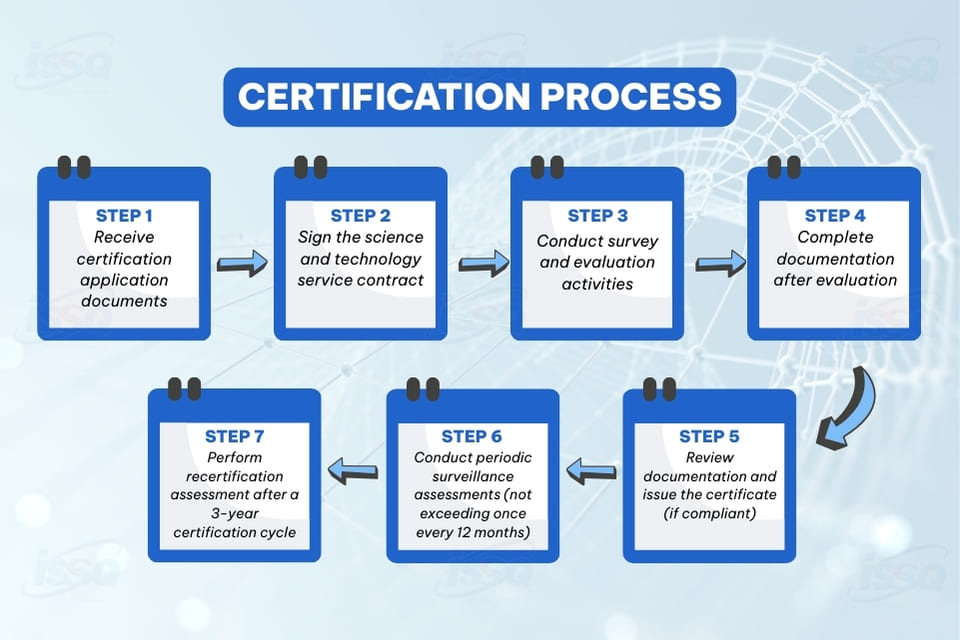
To obtain ISO 9001, ISO 14001, and ISO 45001 certification, businesses typically follow these basic steps:
Step 1: Receive certification registration documents
Step 2: Sign the science and technology service contract
Step 3: Conduct surveys and assessments
Step 4: Complete documentation after assessment
Step 5: Review documents and issue certificates (if compliant)
Step 6: Conduct surveillance audits at intervals not exceeding 12 months
Step 7: Conduct recertification audits (certificates expire after 3 years)
Integrating ISO 9001, ISO 14001, and ISO 45001 not only helps businesses manage operations more effectively but also creates a solid foundation for stable and long-term development.
Instead of operating multiple separate systems, businesses can establish a unified management system to simultaneously control quality, environmental management, and occupational safety. This is also an effective way to optimize resources, enhance reputation, and improve competitiveness in the market.
When properly implemented, integrating these three standards becomes a valuable management tool that supports businesses in developing in a more professional, sustainable, and efficient direction.
If your company requires ISO 9001, ISO 14001, or ISO 45001 certification assessment services, please contact ISSQ Quality Institute via Hotline: (+84) 981851111 or email: vienchatluong@issq.org.vn | tcvn@issq.org.vn for support and procedures.
Published Date: 24/04/2026


