
INSTITUTE FOR STANDARD AND QUALITY DEVELOPMENT STUDIES


22/08/2026
From July 1, 2026, the product and goods quality management system in Vietnam undergoes an important transition as management is oriented according to the risk level of products and goods. Instead of solely focusing on whether a item belongs to a controlled list or not, state management authorities will rely on the severity of hazards, the likelihood of risk occurrence, and potential consequences to select appropriate management measures.
This is a particularly crucial issue for manufacturing enterprises, importing enterprises, and companies trading or distributing products, as correctly identifying the risk group directly impacts requirements regarding technical standards, technical regulations, conformity assessment, declaration of conformity, quality inspection, and documentation before placing products on the market.
The important legal basis currently is Decree No. 37/2026/ND-CP dated January 23, 2026, of the Government, detailing a number of articles and measures for the organization and implementation guidance of the Law on Product and Goods Quality.
Under Article 4 of Decree 37/2026/ND-CP, products and goods are classified into 03 risk levels, including:
High-risk group;
Medium-risk group;
Low-risk group.
Among them, high-risk goods are products with major hazard levels and a high probability of risk occurrence, which can cause severe or particularly severe consequences if appropriate management measures are not applied.
Medium-risk goods are products with moderate hazard levels or moderate risk probabilities, which can cause significant impacts if not properly managed.
Meanwhile, the low-risk group consists of products with minor hazard levels or a low probability of risk occurrence, causing virtually no significant impact under standard controlled conditions or normal use.
Important Note
This is a point enterprises must pay special attention to.
Not all goods on the Vietnamese market are classified under a single Circular. Line management ministries will issue separate lists within their respective scope of state responsibility.
For example, in the field under the Ministry of Industry and Trade, Circular No. 33/2026/TT-BCT dated June 30, 2026, issued the List of products and goods with medium and high risk levels under the state management responsibility of the Ministry of Industry and Trade. The Circular takes effect from July 1, 2026.
For the field under the Ministry of Science and Technology, Circular No. 36/2026/TT-BKHCN dated June 30, 2026, issued the List of products and goods with medium and high risk levels under the management responsibility of the Ministry of Science and Technology, which also takes effect from July 1, 2026.
In addition, other line management ministries also issue corresponding lists. For instance, the Official Gazette records Circular 41/2026/TT-BXD dated June 26, 2026, issuing the list of medium and high-risk products and goods in the field of building materials under the management scope of the Ministry of Construction,...
Therefore, when an enterprise asks "Which risk group does my product belong to?", it is necessary to simultaneously determine:
Which Ministry manages the product's field?
What is the product's HS code?
Is the product listed in the high or medium-risk list of the specialized managing Ministry?
Does the product fall under a corresponding national technical regulation (QCVN)?
What quality management measures are prescribed for the product?
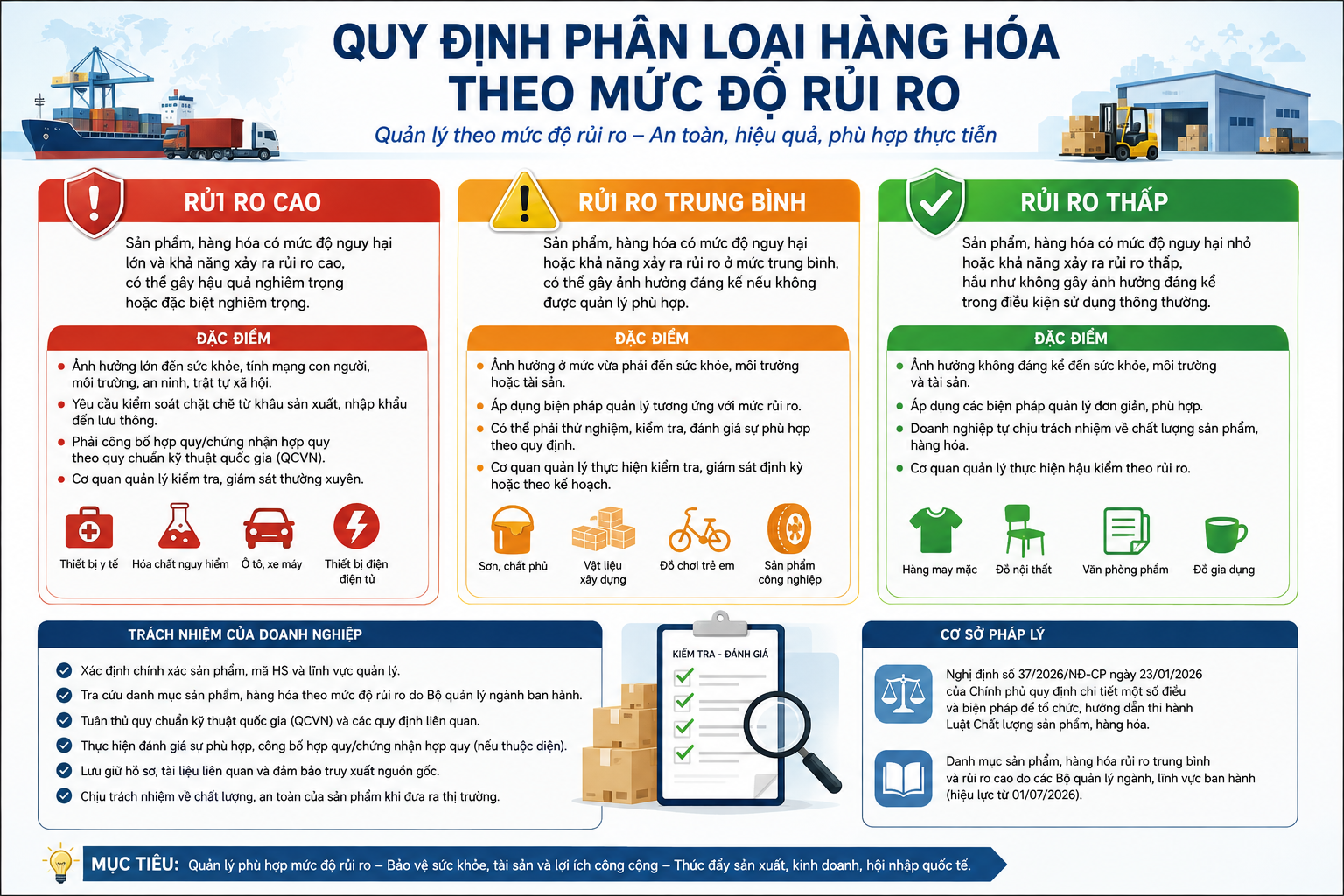
The high-risk group requires regulatory authorities to apply stricter control measures due to the significant hazard posed to humans, the environment, property, or public interests.
According to Decree 37/2026/ND-CP, when determining the risk level, managing authorities must evaluate each hazard and select the hazard with the highest risk score as the basis for assessing the product/item's risk level.
For manufacturing or importing enterprises handling goods in this group, special attention must be paid to:
Applicable national technical regulations;
Technical parameters and safety requirements;
Product testing;
Conformity assessment;
Conformity certification if required by specialized regulations;
Declaration of conformity;
Quality inspection of goods;
Technical documentation and quality proof files;
Labeling;
Traceability;
Record keeping for post-market inspection.
Products should not be placed on the market based solely on internal testing results if specialized law mandates a compulsory conformity assessment scheme.
No.
This is one of the misconceptions that enterprises must avoid.
"Medium-risk goods" does not equate to goods being exempt from quality requirements.
According to Circular 33/2026/TT-BCT, for products on the Ministry of Industry and Trade's medium or high-risk list, quality management is carried out under quality management regulations under the Ministry's responsibility and corresponding national technical regulations.
Therefore, enterprises must examine specific management requirements attached to each product rather than just looking at the words "medium risk".
For example, a product in the medium-risk group may still need to meet QCVN, undergo testing, or fulfill conformity assessment procedures if required by specialized regulations.
It should not be understood that way.
The low-risk group is defined as products with minor hazard levels or low risk probability under normal conditions of use.
However, low-risk products must still comply with relevant legal provisions, such as:
Quality requirements;
Product labeling;
Country of origin;
Product safety;
Responsibilities of manufacturers and importers;
Specialized regulations;
Regulations on advertising and product information;
Regulations on traceability if applicable.
Importantly, not being on the medium or high-risk list does not mean a product is exempt from all quality management regulations. Circular 33/2026/TT-BCT also stipulates that goods not on this list are still managed according to specialized laws and related legal documents.
For manufacturing enterprises, a review should be conducted according to the following process:
Step 1: Accurately identify products
Enterprises need to list all currently manufactured products, including:
Product name;
Model/type;
Composition;
Uses/functions;
Technical specifications;
Target user group;
HS code if import/export activities are involved.
Step 2: Identify the specialized managing Ministry
Do not look up just a single Circular.
It is necessary to determine which Ministry manages the product in order to look up the correct corresponding risk list.
Step 3: Look up HS codes
For importing enterprises, the HS code is particularly important information.
Risk lists are constructed in association with HS codes for convenient product identification and state administration. Decree 37/2026/ND-CP also requires Ministries to construct lists accompanied by HS codes consistent with Vietnam's Export and Import Classification Nomenclature.
Step 4: Identify applicable QCVN/TCVN
After determining the risk group, enterprises must continue identifying whether the product falls within the governing scope of any QCVN.
If a mandatory QCVN exists, enterprises must properly execute the prescribed conformity assessment scheme.
Step 5: Prepare quality dossiers
Enterprises should proactively build and retain:
Technical dossiers;
Applied standards;
Test result reports;
Conformity assessment records;
Conformity certificates if mandatory;
Conformity declaration forms;
Raw material origin records;
Production records;
Quality inspection records;
Labeling documentation;
Traceability records.
For importing enterprises, legal risks can arise right from the import documentation preparation stage.
Enterprises should check before signing contracts or importing goods, rather than waiting until goods arrive at the port to determine requirements.
A verification process should include:
Product name → intended use → technical specifications → HS code → Managing Ministry → risk level → applicable QCVN → conformity assessment scheme → import documentation → quality inspection → pre-market procedures.
In particular, enterprises must clearly distinguish between:
"Goods on the high-risk list"
and
"Goods subject to mandatory conformity certification".
These two concepts are related but should not be equated as identical. Whether a product requires conformity certification or not must be determined based on QCVN and corresponding quality management requirements.
For enterprises operating in manufacturing, importing, and distribution, priority should be given to reviewing product groups likely subject to specialized quality management requirements, such as:
Children's toys;
Building materials;
Electrical and electronic equipment;
Products containing chemicals;
Paints and products related to heavy metal limits;
Machinery and equipment;
Industrial products;
Food and beverages;
Products posing potential health impacts;
Products/goods serving sectors with specific safety requirements.
However, enterprises should not rely solely on the product group name. It is essential to cross-check exact HS codes, product characteristics, and the current list of the specialized managing Ministry.
For enterprises within the management scope of the Ministry of Industry and Trade, Circular 33/2026/TT-BCT is a document requiring special attention starting July 1, 2026.
The Circular issues the list of medium and high-risk products and goods attached with HS codes, QCVNs, and corresponding quality management requirements.
The Circular also replaces the previous catalog mechanism under Circular 41/2023/TT-BCT as of July 1, 2026.
This means enterprises should not mechanically continue using old lists, but rather review products against the new list.
To minimize risks when the risk-level management mechanism is implemented, enterprises should perform at least 7 tasks:
First, review the entire catalog of products being manufactured, imported, and traded.
Second, determine exact HS codes for imported goods.
Third, identify the specialized managing Ministry for each product.
Fourth, look up currently effective lists of medium-risk and high-risk products.
Fifth, identify applicable QCVNs, TCVNs, and conformity assessment schemes.
Sixth, re-check quality dossiers, testing reports, conformity certificates, and declarations of conformity if applicable.
Seventh, establish a process for periodic legal updates, as risk lists may be reviewed, updated, and supplemented based on practical circumstances, new products, emerging technologies, and domestic/international risk alerts.
The regulation classifying products and goods into high risk, medium risk, and low risk is a key content in the new product/goods quality management framework.
The foundational legal basis is Decree 37/2026/ND-CP, which sets out principles, methods, and the three risk levels. Subsequently, line ministries issue lists of medium and high-risk products and goods within their management scope.
In particular, from July 1, 2026, enterprises must proactively update the new lists issued by each Ministry. For instance, enterprises under the management scope of the Ministry of Industry and Trade need to review Circular 33/2026/TT-BCT, while those under the Ministry of Science and Technology should note Circular 36/2026/TT-BKHCN.
Early review will help enterprises avoid situations where goods have arrived but lack sufficient quality documentation, products have been manufactured but haven't completed conformity assessments, or items are placed on the market before meeting specialized management requirements.
👉 See more: Product portfolio certified under QCVN 3:2019/BKHCN
For assistance with certification procedures, please contact us via hotline: 0981851111 or email: vienchatluong@issq.org.vn | tcvn@issq.org.vn


