
INSTITUTE FOR STANDARD AND QUALITY DEVELOPMENT STUDIES


25/09/2026
Rubber gloves are widely used in food processing, manufacturing, and trading to ensure hygiene and reduce cross-contamination risks. However, not all enterprises clearly understand whether this product falls under mandatory conformity certification according to current regulations.
Join the Institute for Standards and Quality Development Research (ISSQ Quality Institute) to explore whether food-contact rubber gloves require QCVN 12-2 conformity certification, the applicable entities, and key requirements enterprises must satisfy before launching products into the market.
According to QCVN 12-2:2011/BYT – National Technical Regulation on Safety and Hygiene for Rubber Packaging and Utensils in Direct Contact with Food, products made from rubber used to contain, wrap, or directly contact food fall under the regulatory scope if they are placed on the market.
Rubber gloves used during food preparation, processing, packaging, or serving are utensils in direct contact with food. Therefore, for products within the scope of QCVN 12-2:2011/BYT, manufacturing or importing enterprises must fulfill safety requirements under the regulation prior to product distribution.
Specifically, QCVN 12-2 applies to organizations and individuals manufacturing, importing, and trading rubber utensils in direct contact with food within the territory of Vietnam. These products must meet prescribed safety limits to restrict the risk of harmful substance migration into food, contributing to consumer health protection.
Note: Not all types of rubber gloves fall under the scope of QCVN 12-2. This regulation applies only to gloves designed and intended for direct contact with food. Gloves intended for medical, industrial, or general labor protection purposes are governed by their respective specialized regulations.

Rubber gloves in direct contact with food can affect food quality and safety levels if they do not meet material and safety requirements. Therefore, conformity certification under QCVN 12-2:2011/BYT serves as the basis for controlling product quality before market distribution.
Risk of Substance Migration from Gloves into Food: If safety criteria are not met, rubber gloves may pose a risk of substance migration that negatively impacts food quality.
Difficulty in Market Quality Control: Diversity in product origins and quality makes it difficult for enterprises and consumers to evaluate product safety without formal certification activities.
Regulatory Requirements for Food-Contact Products: Rubber gloves in direct contact with food belong to a product group managed under technical regulations to ensure user safety.
Risk of Non-Compliance During Distribution: Enterprises that fail to conduct conformity certification and declaration for mandatory items may encounter operational disruptions during manufacturing, importing, and commercial distribution.
Determining whether a product falls under QCVN 12-2:2011/BYT and completing conformity certification in compliance with regulations is an essential step for enterprises to lawfully launch products into the market.
Certifying food-contact rubber gloves under QCVN 12-2 not only helps enterprises comply with legal mandates but also improves product quality and creates advantages in production and business activities. Key benefits include:

Legal Compliance: Helps enterprises fulfill certification and declaration requirements for products governed by QCVN 12-2, mitigating legal risks during distribution.
Assisting Food Safety Assurance: Confirms product compliance with safety standards, helping limit harmful substance migration risks into food and protecting consumer health.
Enhancing Credibility and Customer Trust: Demonstrates regulatory compliance and corporate commitment to product quality, thereby strengthening trust among clients and partners.
Facilitating Business and Production Operations: Meets requirements of distributors and food processing facilities, paving the way for smooth product introduction to the market.
Boosting Competitive Advantage: Creates a competitive edge, enhances brand image, and expands partnership opportunities within the food supply chain.
Conformity certification under QCVN 12-2 is not only a mandatory requirement for many food-contact rubber glove products but also a strategic solution for enterprises to validate quality, elevate reputation, and achieve sustainable growth.
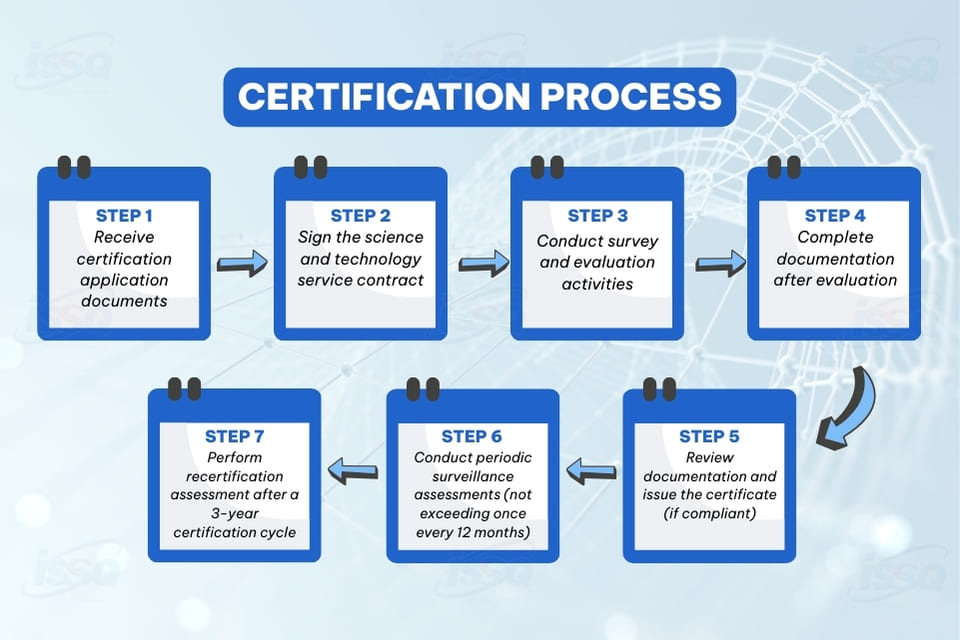
To obtain a conformity certificate under QCVN 12-2, enterprises must perform full evaluation steps as regulated. The certification procedure verifies product safety prior to market release through the following basic steps:
Step 1: Receipt of certification application dossier.
Step 2: Signing of science and technology service contract.
Step 3: Survey and evaluation assessment.
Step 4: Post-assessment dossier completion.
Step 5: Dossier appraisal and certificate issuance (if compliant).
Step 6: Surveillance evaluation (conducted at intervals not exceeding 12 months).
Step 7: Re-certification evaluation upon certificate expiration.
Food-contact rubber gloves require high safety standards due to their direct impact on food quality and consumer health. For products within the scope of QCVN 12-2:2011/BYT, enterprises must complete conformity certification and declaration in accordance with regulations before launching products into the market.
If your company requires support with QCVN 12-2:2011/BYT evaluation and certification procedures for food-contact rubber gloves, please contact ISSQ Quality Institute via hotline: 0981851111 or email: vienchatluong@issq.org.vn | tcvn@issq.org.vn for assistance.


