
INSTITUTE FOR STANDARD AND QUALITY DEVELOPMENT STUDIES


13/08/2026
In the context of rapid digital transformation and innovation, information security has become an important factor in the competitiveness and sustainable development of businesses. According to the Institute for Standard and Quality Development Studies (ISSQ Quality Institute), implementing and obtaining ISO/IEC 27001 certification not only helps businesses control risks and protect information assets but also establishes a solid governance foundation for applying technology and developing new business models.
The application of Cloud Computing, Artificial Intelligence (AI), Big Data, and the Internet of Things (IoT) is helping Vietnamese businesses optimize production and business operations, improve productivity, and create new value. However, the digitalization process also increases the risks of data leakage, cyberattacks, information theft, and system disruptions.
In this context, information security is no longer the sole responsibility of the IT department but has become an important component of corporate governance. To achieve effective digital transformation, businesses need to establish a systematic management mechanism to identify, assess, and control information-related risks.
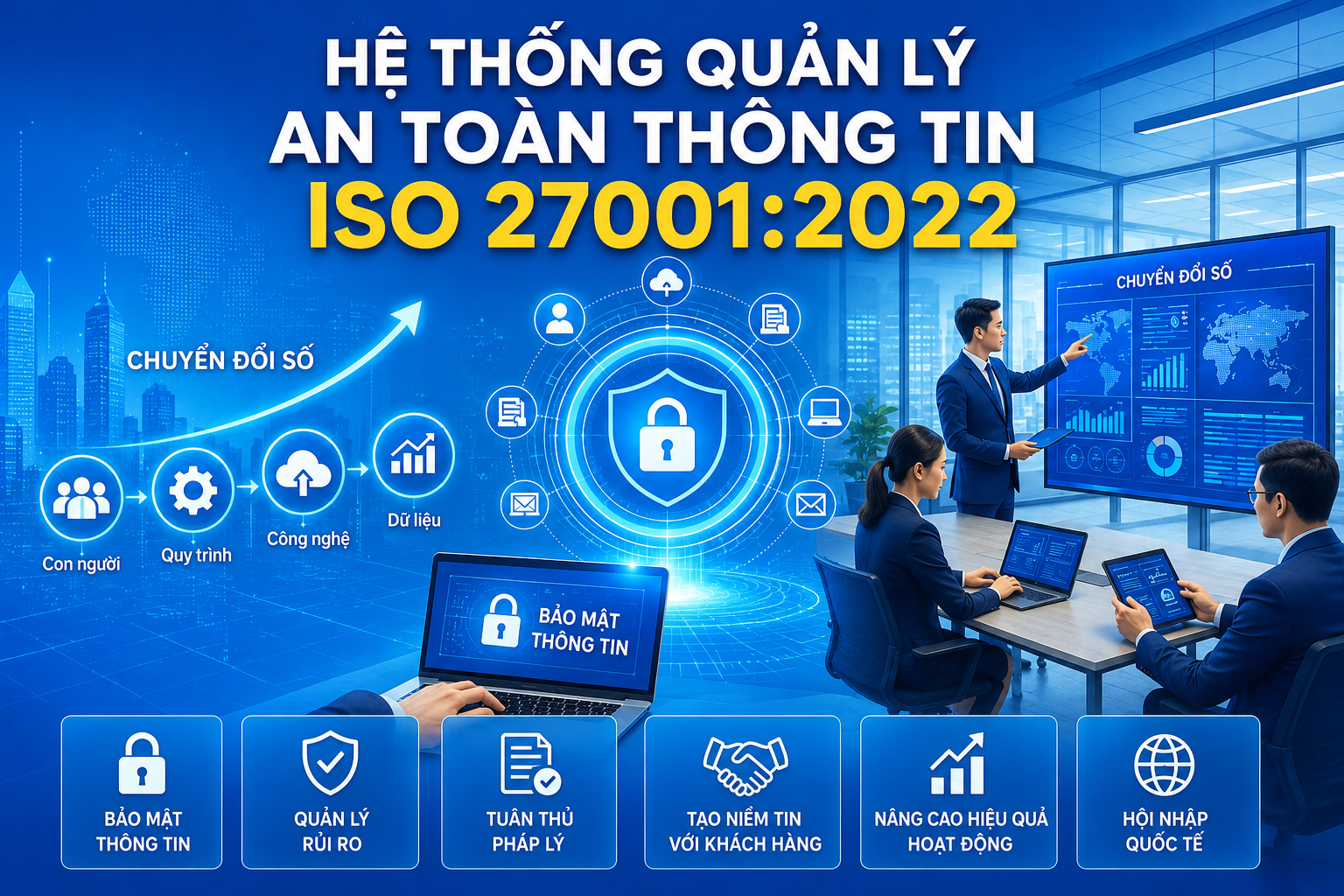
ISO/IEC 27001 is an international standard for an Information Security Management System (ISMS), issued by the International Organization for Standardization (ISO) and the International Electrotechnical Commission (IEC). The standard provides a framework that enables organizations to establish, operate, maintain, and continually improve their information security management systems, based on three core principles: Confidentiality, Integrity, and Availability (CIA) of information.
Through a risk-based management approach, ISO/IEC 27001 helps businesses identify threats, implement appropriate controls, and improve their ability to respond to information security incidents. It is also a standard adopted by many organizations worldwide to enhance governance capabilities and strengthen the trust of customers and business partners.
Establishing a management system in accordance with ISO/IEC 27001 also contributes to creating a safer environment for businesses to adopt new technologies. When data, systems, and management responsibilities are clearly controlled, businesses can accelerate innovation while ensuring information security and operational continuity.
ISO/IEC 27001 can be applied to organizations of all types, regardless of their size or field of operation. The standard is particularly suitable for businesses that frequently collect, store, process, or share important data, such as information technology, telecommunications, finance and banking, e-commerce, healthcare, logistics, smart manufacturing, and digital service providers.
In addition, businesses seeking to implement digital transformation, develop technology products, provide digital-platform-based services, or participate in global supply chains should also consider establishing an Information Security Management System in accordance with ISO/IEC 27001. This provides a foundation for businesses to meet the increasingly stringent information security requirements of customers, partners, and the market.
For internal operations, implementing ISO/IEC 27001 helps businesses standardize information management processes, clearly define the roles and responsibilities of each department, and proactively identify risks that may affect data and systems. Control measures are established based on actual risk levels, enabling businesses to allocate resources appropriately and improve their ability to respond to incidents.
An Information Security Management System supports businesses in protecting digital assets, reducing the risk of operational disruptions, and maintaining business continuity. This provides an important foundation for businesses to implement digital transformation projects, research new products, and adopt technologies in a controlled manner.
For customers and business partners, ISO/IEC 27001 certification serves as independent evidence that a business has established and maintained an Information Security Management System in accordance with an international standard. This contributes to strengthening confidence in the organization's ability to protect data, fulfill confidentiality commitments, and control relevant risks throughout the cooperation process.
In the digital economy, many customers, business partners, and international supply chains consider ISO/IEC 27001 certification an important criterion when evaluating and selecting suppliers. Therefore, obtaining certification can help businesses enhance their reputation, strengthen their competitive advantage, meet bidding requirements, and expand cooperation opportunities in both domestic and international markets.
Digital transformation can only deliver sustainable results when accompanied by appropriate information governance and protection capabilities. ISO/IEC 27001 not only supports businesses in controlling risks but also provides a foundation for technology adoption, business model innovation, and building trust with customers and partners.
With experience in the fields of standards, metrology, and quality, the ISSQ Quality Institute provides assessment and certification services for Information Security Management Systems according to ISO/IEC 27001. The certificate is recognized by the International Accreditation Forum (IAF).
The assessment activities are conducted based on the principles of independence, objectivity, and compliance with applicable regulations, thereby helping businesses confirm the conformity of their management systems, improve governance effectiveness, and meet development requirements throughout the digital transformation process.
If your company needs support with the ISO 27001 certification procedures for an Information Security Management System, please contact us via: +84 923671234 or vienchatluong@issq.org.vn | tcvn@issq.org.vn


