
INSTITUTE FOR STANDARD AND QUALITY DEVELOPMENT STUDIES


16/04/2026
As food safety requirements continue to receive greater attention, many businesses are interested in applying suitable management systems to control risks and improve product quality throughout the supply chain. ISO 22000 and HACCP are two widely used standards that are often considered when building management systems in the food industry.
Let’s explore with the ISSQ Quality Institute how these two systems can be combined to improve food safety management efficiency in the article below.
ISO 22000 is an international standard for Food Safety Management Systems (FSMS), specifying requirements that help organizations establish, implement, maintain, and improve a system to control hazards affecting food safety throughout the entire supply chain.
This system is designed for all organizations directly or indirectly involved in the food chain, from production, processing, and transportation to distribution and related services.
ISO 22000 aims to ensure that food products are:
One of the core features of ISO 22000 is the integration of multiple management elements within one system, including:
As a result, ISO 22000 does not stop at hazard control but also helps businesses establish a structured management system capable of stable operation and continuous improvement over time.
HACCP (Hazard Analysis and Critical Control Point) is a hazard analysis and critical control point system developed to identify, assess, and control hazards that may affect food safety throughout the production and supply process.
It is a scientific and systematic approach that helps organizations:
Unlike traditional inspection methods, HACCP focuses on preventing risks from the beginning, ensuring food safety throughout the entire chain – from raw materials, processing, storage, and distribution to final consumption.
The HACCP system can be applied flexibly to many types of organizations within the food chain, with the core objectives of:
In addition, HACCP is built on 7 core principles, forming the foundation for establishing and operating a structured and effective food safety control system.
HACCP is not only a control tool but also a preventive management method that helps businesses ensure food safety proactively and systematically.

The integration of ISO 22000 and HACCP is essentially the combination of a management standard and a food safety control tool. This combination helps businesses build a system that is both comprehensive in management and effective in risk control.
This system focuses on identifying specific hazards within the food chain, establishing control measures at critical control points (CCPs), and ensuring food safety through process control rather than only final product inspection.
ISO 22000 is a Food Safety Management System standard that helps businesses establish a systematic management structure, control documents, records, and processes, clearly define responsibilities, resources, and internal communication, and maintain and continually improve the system.
In other words, ISO 22000 acts as the “management framework,” while HACCP serves as the core hazard control component.
When integrating ISO 22000 and HACCP, businesses can:
This combination helps standardize processes from input to output, establish clear monitoring, verification, and record-keeping mechanisms, and improve traceability in case of incidents.
This is especially important as food supply chains become increasingly complex.
Many markets and international partners require businesses to have a food safety management system capable of scientifically demonstrating hazard control.
Combining ISO 22000 and HACCP helps businesses improve credibility, more easily meet assessment and certification requirements, and enhance competitiveness.
HACCP helps control hazards, while ISO 22000 helps manage that control system in a structured manner. When combined, businesses can not only ensure food safety technically but also maintain stability, transparency, and long-term improvement.

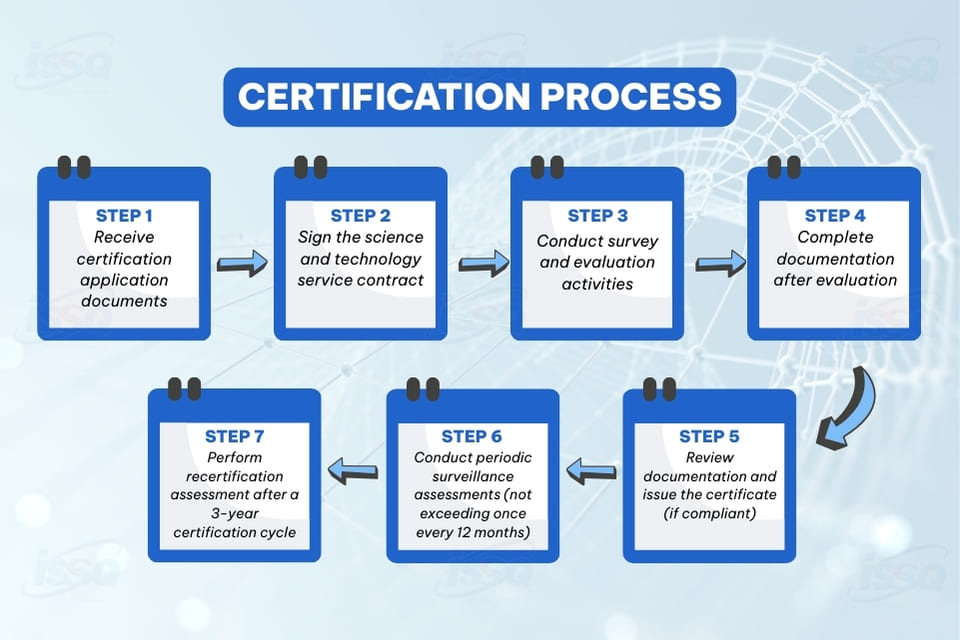
The ISO 22000 and HACCP certification process is generally implemented through the following steps:
Step 1: Receive the certification registration documents
Step 2: Sign the scientific and technological service contract
Step 3: Conduct surveys and assessments
Step 4: Complete documentation after the assessment
Step 5: Review the documentation and issue the certificate (if compliant)
Step 6: Conduct surveillance assessments at intervals not exceeding 12 months
Step 7: Conduct recertification assessments after the 3-year certification cycle expires
ISO 22000 and HACCP are not two separate systems but closely complementary approaches, in which HACCP serves as the technical foundation for hazard control, while ISO 22000 provides the management framework that ensures these activities are implemented systematically and maintained effectively over the long term.
Combining these two approaches helps businesses not only ensure food safety at every stage but also build a synchronized, transparent management system capable of continuous improvement. This is an important foundation for enhancing credibility, meeting market requirements, and moving toward sustainable development in the food industry.
If your company needs ISO 22000 and HACCP certification assessment services, please contact the ISSQ Quality Institute via hotline: +84 981 851 111 or email: vienchatluong@issq.org.vn | tcvn@issq.org.vn for support.
Published Date: 10/04/2026


