
INSTITUTE FOR STANDARD AND QUALITY DEVELOPMENT STUDIES


06/01/2024
Effective educational management not only provides quality learning experiences for learners but also contributes to the long-term development of educational organizations. ISO 21001 certification provides processes and guidelines that help educational institutions establish a sound management system, thereby managing education effectively and achieving the greatest possible benefits.

ISO 21001:2018 is a standard developed by the International Organization for Standardization (ISO), and the version issued in Vietnam is ISO 21001:2018. ISO 21001 certification operates as a management tool for educational organizations to provide educational products and services, helping schools meet the needs of students, teachers, and other related parties.
ISO 21001 is a standard applicable to all educational organizations, regardless of type, size, or delivery method. In addition, ISO 21001 can also be applied not only to specialized educational institutions but also to smaller educational units within larger organizations whose primary activities are not educational in nature, such as educational agencies, professional training centers, vocational training organizations, etc.
Applying the ISO 21001 Standard helps educational institutions demonstrate social responsibility and enhance the reputation of the organization by providing comprehensive quality education.
Furthermore, implementing ISO 21001 demonstrates the commitment of educational organizations to continuously improving educational quality, meeting the needs not only of learners but also of educators, parents, and other interested parties through enhanced innovation processes within educational organizations.
ISO 21001:2018 is structured into 10 clauses following the High-Level Structure (HLS) used in modern ISO management system standards. Clause 1 defines the scope, Clause 2 explains normative references, and Clause 3 explains the terms used in educational standards. The remaining clauses are structured according to the HLS format that users may already be familiar with from ISO 9001.
The basic structure of the management system standard includes:
In the annex section (Annex A – Guidelines for the early childhood education sector), you will find a great deal of practical advice on implementation. ISO 21001 establishes 11 management principles detailed in Annex B (with additional information), including:
Annexes C to G provide information mainly focused on interested parties, processes, benchmarks, and tools within educational organizations.
To ensure high and consistent educational quality, ISO 21001 emphasizes several concepts related to educational management best practices, specifically as follows:
As a result, educational organizations can improve quality by integrating these concepts and objectives into teaching methods. In addition, organizations need to establish, implement, maintain, and continually improve their management system based on the following activities:
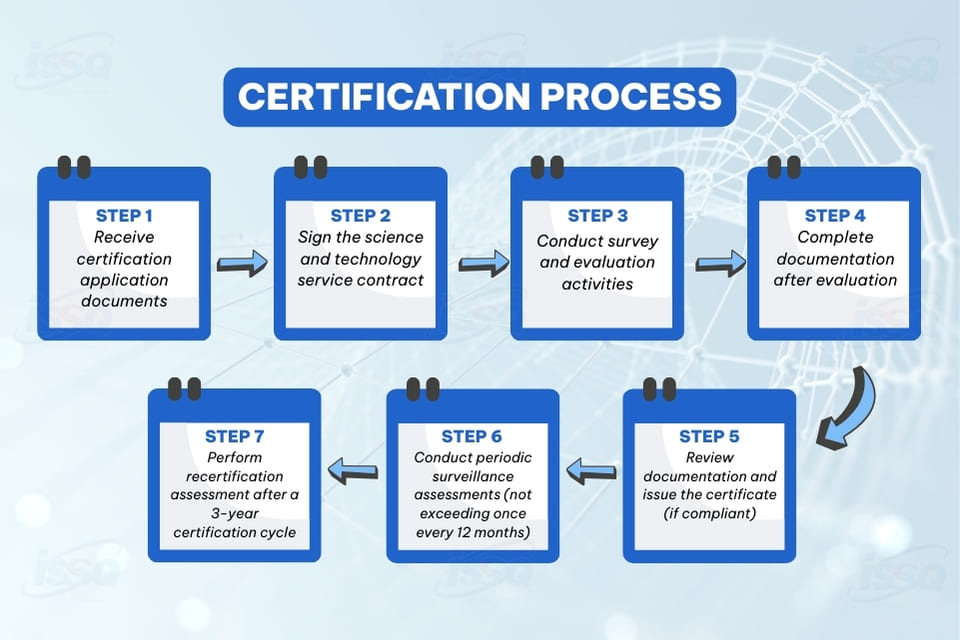
Step 1: Receive certification registration documents
Step 2: Sign a scientific and technological service contract
Step 3: Conduct surveys and assessments
Step 4: Complete documentation after assessment
Step 5: Review documentation and issue certification (if compliant)
Step 6: Conduct surveillance assessments every 12 months
Step 7: Conduct recertification assessment (certificate validity: 3 years)
The above information summarizes the content of ISO 21001 Certification – Educational Organizations Management System 21001.
ISSQ Quality Institute is always ready to accompany businesses during the period of integration and development.
Please contact Hotline: (+84) 981851111 or email: vienchatluong@issq.org.vn | tcvn@issq.org.vn. We are honored to serve our valued customers!
Published date: 06/01/2024


