
INSTITUTE FOR STANDARD AND QUALITY DEVELOPMENT STUDIES


09/03/2023
Food-supplying enterprises that apply and obtain ISO 22000 certification are recognized as organizations with effective food hygiene and safety management systems and are capable of providing safe, high-quality food products to consumers.
So, what are the frequently asked questions about ISO 22000 certification?
ISO 22000 certification covers all processes within the food chain that affect the safety of the final product. This standard specifies requirements for a comprehensive food safety management system and integrates elements of Hazard Analysis and Critical Control Points (HACCP) and Good Manufacturing Practices (GMP).
ISO 22000 has established a unified food safety standard that harmonizes various national standards into a set of requirements that are easy to understand, easy to apply, and recognized worldwide.
This internationally recognized food safety standard can be used by all organizations in the food supply chain, from farming and food services to processing, transportation, storage, packaging, and retail.
On June 19, 2018, the International Organization for Standardization (ISO) officially published the new version ISO 22000:2018 – Food Safety Management Systems – Requirements for organizations in the food chain, replacing the 2005 version issued on September 1, 2005.
Currently, many food enterprises are wondering whether having ISO 22000 certification means they no longer need to obtain a Certificate of Eligibility for Food Safety and Hygiene.
According to Decree No. 15/2018/ND-CP, enterprises that have been granted ISO 22000 certification are not required to apply for the Certificate of Eligibility for Food Safety and Hygiene.
In addition, this regulation provides detailed provisions for the implementation of several articles of the Law on Food Safety: “Enterprises that have been granted one of the following certificates: Good Manufacturing Practices (GMP), HACCP, or ISO 22000 are not required to obtain the Certificate of Eligibility for Food Safety and Hygiene.”
This means that enterprises with ISO 22000 certification do not need to apply for the Certificate of Eligibility for Food Safety and Hygiene.
Yes, ISO 22000 certification can be integrated with other certifications such as ISO 9001 or ISO 45001.
This is because ISO 22000 is developed based on the High-Level Structure (HLS), making it easier to integrate ISO 22000 with other ISO management system standards.
Enterprises that have only registered their business operations but have not yet started actual production activities are not eligible to register for ISO 22000 certification assessment.
With ISO 22000 certification, enterprises may gain several benefits such as: exemption from food safety licensing requirements; reduction in costs related to product recall and destruction; increased opportunities to expand into global markets; improvement and enhancement of food safety management systems, etc.
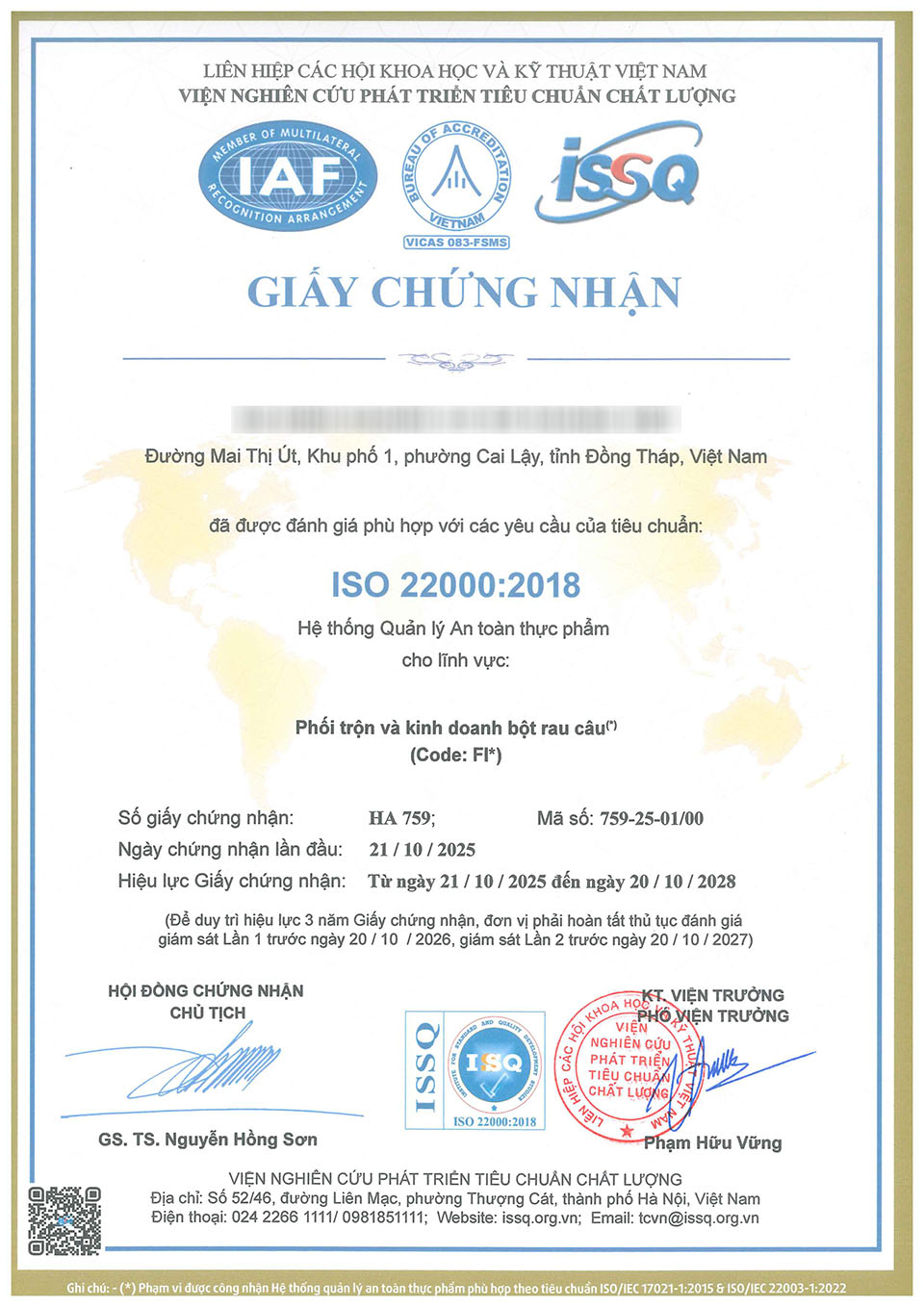
Typically, an ISO 22000 certificate is valid for three years from the date of issuance. Surveillance audits are conducted once a year to ensure that the system is maintained effectively and remains valid.
The surveillance cycle is usually conducted annually; in some cases, it may occur every 6–9 months depending on the requirements of each certification body.
After three years, if the enterprise wishes to maintain certification, it must undergo a recertification audit.
This audit is conducted similarly to the initial certification audit.
The renewed ISO 22000 certificate will again be valid for three years.
The primary objective of ISO 22000 certification is to ensure that food enterprises are capable of controlling all potential hazards. These hazards may arise at any stage, from raw material preparation to farming, fishing, harvesting, processing, and distribution to consumers.
To achieve this, enterprises must establish and implement prerequisite programs, along with a comprehensive control system and supporting documentation to minimize risks that could affect food safety levels.
With the above basic information, we hope our knowledge has helped you better understand the frequently asked questions about ISO 22000 certification.
ISSQ Quality Institute is always ready to accompany companies during the period of integration and development.
Please contact our hotline: +84 981 851 111 or email vienchatluong@issq.org.vn | tcvn@issq.org.vn — we are honored to serve you!
Posted on: March 9, 2023


